Dental service
Root Canal Treatment in San Carlos, CA
Root canal treatment can relieve tooth pain, treat infection and help save your natural tooth.
Root Canal Treatment: What Is a Root Canal and When Do You Need One?
If you've been told you need a root canal, you may immediately think of pain. In reality, root canal treatment is performed to relieve pain, remove infection and, whenever possible, save your natural tooth.
At Aashvi Smiles Dental Group in San Carlos, CA, our goal is to help you understand why your tooth hurts, whether a root canal is necessary, and what options you have before beginning treatment.
What Is a Root Canal?
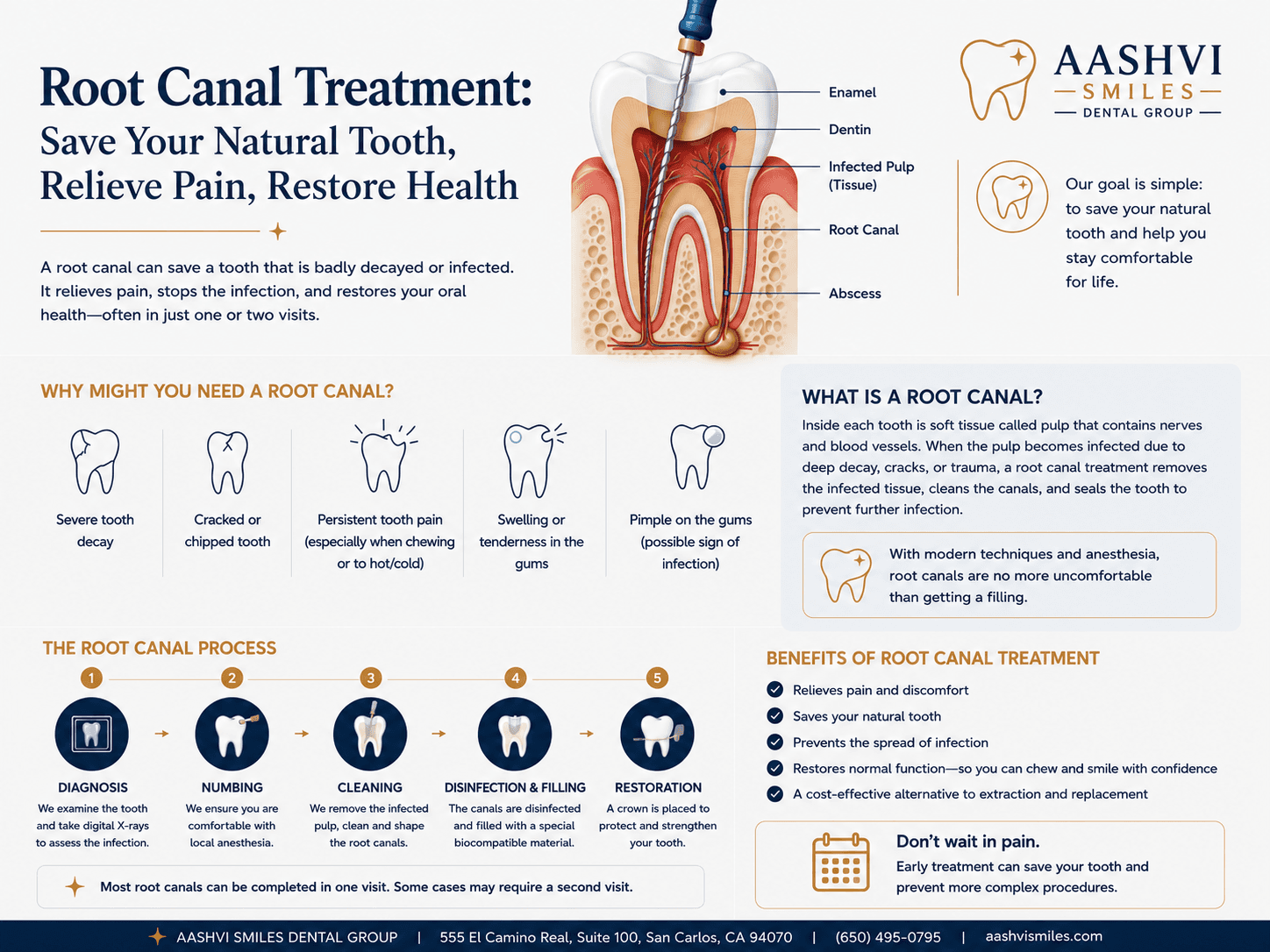
Inside every tooth is a space containing soft tissue called the dental pulp. The pulp contains nerves, blood vessels and connective tissue.
Deep decay, a crack or fracture, trauma, or other damage can allow the pulp to become inflamed or infected.
During root canal treatment, the affected pulp is removed from inside the tooth. The canals within the roots are carefully cleaned, disinfected, shaped and filled to help prevent reinfection.
The tooth can then be restored so you can continue using it.
Why Might I Need a Root Canal?
A root canal may be recommended when the pulp inside a tooth has become irreversibly inflamed, damaged or infected.
Possible symptoms include:
- Persistent or significant tooth pain
- Pain when biting or chewing
- Lingering sensitivity to hot or cold
- Swelling or tenderness around a tooth
- A pimple or bump on the gums
- A cracked, fractured or severely damaged tooth
- Deep tooth decay
- Darkening or discoloration of a tooth
Importantly, not every tooth that needs root canal treatment hurts. Sometimes an infection is discovered during an examination or on a dental X-ray.
That's one reason regular dental examinations are important even when your teeth feel fine.
Does a Root Canal Hurt?
This is one of the most common questions patients ask.
The purpose of root canal treatment is actually to address the source of tooth pain, rather than cause it.
Local anesthetic is used to numb the tooth and surrounding area during treatment. Your individual experience will depend on the condition of the tooth and complexity of treatment, and some tenderness afterward can occur as the surrounding tissues heal.
If you're nervous about treatment, tell us. Understanding what will happen before we begin can make the experience considerably less intimidating.
What Happens During Root Canal Treatment?
Although every tooth is different, treatment generally follows several steps.
1. Examination and Diagnosis
We first examine the tooth and surrounding tissues and may take digital X-rays to evaluate the roots and surrounding bone.
Most importantly, we determine whether root canal treatment is actually the appropriate treatment for your tooth.
2. Making You Comfortable
The area is numbed with local anesthetic before treatment begins.
3. Removing the Infected or Damaged Pulp
A small opening is created in the tooth so the dentist can access the pulp chamber and root canals.
The inflamed or infected tissue is carefully removed.
4. Cleaning and Disinfecting the Canals
The canals are shaped, cleaned and disinfected to remove tissue and reduce bacteria inside the tooth.
5. Filling and Sealing the Tooth
The cleaned canals are filled and sealed to help prevent bacteria from entering them again.
Depending on the tooth and clinical circumstances, treatment may be completed in one appointment or require additional visits.
Will I Need a Crown After a Root Canal?
Often, particularly for back teeth such as premolars and molars, a crown may be recommended after root canal treatment.
A tooth requiring a root canal may already have lost considerable tooth structure because of decay, fractures, previous fillings or the access needed for treatment.
A dental crown surrounds and protects the remaining tooth structure, helping restore function and allowing you to chew comfortably.
At Aashvi Smiles, we use CEREC digital dentistry, which allows us to digitally scan, design and create many crowns directly in our San Carlos, CA office. For appropriate cases, this can mean completing the final crown without the traditional process of wearing a temporary crown while waiting for a laboratory restoration.
Why Save a Natural Tooth?
When a tooth can be predictably restored, maintaining your natural tooth has important advantages.
Saving the tooth can help you:
- Maintain natural chewing function
- Preserve your existing bite
- Avoid leaving an empty space
- Avoid or postpone the need for tooth-replacement procedures
- Maintain the appearance of your natural smile
However, not every tooth can or should be saved.
If a tooth is severely fractured, has inadequate remaining structure, significant bone support problems or another poor prognostic factor, extraction may sometimes be the better option.
Our philosophy is to explain the condition of the tooth and discuss the reasonable options with you before deciding on treatment.
Root Canal vs. Extraction: Which Is Better?
There isn't one answer for every patient.
If the tooth is restorable and has a good long-term prognosis, root canal treatment may allow you to retain your natural tooth.
If the tooth cannot be predictably restored, extraction may be recommended. The missing tooth can potentially be replaced later with an implant, bridge or removable restoration depending on your circumstances.
When comparing the options, it's important to consider not just today's procedure but also what happens afterward.
Ask questions such as:
- Can this tooth be predictably saved?
- Will it need a crown afterward?
- What is its long-term prognosis?
- If I remove it, do I need to replace it?
- What would replacement involve?
A good treatment decision should take your overall oral health, medical history, priorities and finances into consideration.
What Happens If I Ignore an Infected Tooth?
Dental infections generally shouldn't be ignored.
An infection originating inside a tooth can progress into the tissues and bone surrounding the root and may lead to increasing pain, swelling or an abscess.
If you have significant facial swelling, fever, difficulty swallowing, difficulty breathing, swelling approaching the eye or rapidly worsening symptoms, seek urgent medical or dental attention.
Tooth Pain? Don't Wait Until It Becomes an Emergency
One of the biggest misconceptions about dentistry is that you should wait until a tooth becomes extremely painful before seeing a dentist.
Earlier evaluation may mean more treatment options and a better opportunity to preserve the tooth.
If you have persistent tooth pain, sensitivity, swelling, a broken tooth, or simply feel that something isn't right, it's worth having it evaluated.
Root Canal Treatment in San Carlos, CA
At Aashvi Smiles Dental Group, we believe patients should understand their diagnosis before making decisions about treatment.
Whether your tooth needs a filling, crown, root canal, extraction—or simply needs to be monitored—our goal is to help you understand why and make a decision that is appropriate for your health and priorities.
If you're experiencing tooth pain or have been told you may need a root canal, we welcome you to schedule an evaluation at our San Carlos, CA practice.
Aashvi Smiles Dental Group
555 El Camino Real, Suite 100
San Carlos, CA 94070
650-495-0795
What to expect
Questions about treatment?
Let's plan care around your needs.
Book an appointment online and our team will help plan care around your needs.